Movies you've recently watched

  1. Memento
  2. Prestige — probably Nolan's "actual best movie"
  3. Tenet
  4. Inception — full disclosure: I'd place this lower, but I value my life
  5. Interstellar
  6. Oppenheimer — a spectacle, but still limited by the trappings of being a biopic
  7. Dunkirk
  8. Insomnia — I should revisit this one. I really didn't like it at the time because I'd already seen the Norwegian original, which felt dramatically superior.
  9. Dark Knight Trilogy — ill always rank costumed superhero movies lower than original movies
  10. The Odyssey Trailer

Not particularly a Nolan fan and I haven't seen Dunkirk nor Oppenheimer. I'm not a fan of rankings either but just to drive discussion, and without thinking too much about it, mine would probably look like this.
  • Interstellar
  • Inception
  • Memento
  • The Prestige
  • The Dark Knight Trilogy
  • Insomnia
  • Tenet
 
  • Interstellar
  • Inception
  • Memento
  • The Prestige
  • The Dark Knight Trilogy
  • Insomnia
  • Tenet
While we're at it:
  1. Interstellar
  2. Oppenheimer
  3. The Prestige
  4. Memento
  5. The Dark Knight
  6. Inception
  7. Dunkirk
  8. Batman Begins
  9. Insomnia
  10. The Dark Knight Rises
  11. Tenet (I don't get it)
Haven't watched Following, and I've only watched Tenet once, back when it came out in theaters, I'd probably have a better experience upon a rewatch. Happy to see I'm not the only person on the planet who has Interstellar as his favorite Nolan movie, people rip on that film way too much for really superficial reasons, but I personally adore it. It's the most emotional movie in his filmography, so that might be why it really resonates with me the most. The fact that it's hard science fiction is the icing on top :void:
 
Happy to see I'm not the only person on the planet who has Interstellar as his favorite Nolan movie, people rip on that film way too much for really superficial reasons, but I personally adore it. It's the most emotional movie in his filmography, so that might be why it really resonates with me the most. The fact that it's hard science fiction is the icing on top :void:

Well to be honest I understand the criticism, or at least I specifically think the bridging of the "broken family life" and the "space exploration" aspects is clumsily done. It feels very 1960s sci-fi and would probably work better in written form than visually. It basically breaks the suspension of disbelief because to have him floating inside of a black hole and knocking on the back of a bookcase crosses over from sci-fi into fantasy territory. But even so, it's a great movie with top notch performances, awesome visual effects and even a bit of a message about the environment, self-sacrifice for the greater good and all that.
 
  1. Interstellar
  2. Oppenheimer
  3. The Prestige
  4. Memento
  5. The Dark Knight
  6. Inception
  7. Dunkirk
  8. Batman Begins
  9. Insomnia
  10. The Dark Knight Rises
  11. Tenet (I don't get it)
Personally, Oppenheimer is such a strange movie. It's a mess in my opinion. There's genuine positives but it is incredibly odd(?) with its storytelling choices and also pretty pretentious ngl...

I think my major problem is how Oppenheimer is portrayed. A lot of genuine depth to his character is reduced to his guilt and the Manhattan project which makes him less of a human.

But am curious to know what you think of, considering you seem to rate the movie high.
 
Personally, Oppenheimer is such a strange movie. It's a mess in my opinion. There's genuine positives but it is incredibly odd(?) with its storytelling choices and also pretty pretentious ngl...
Not sure what you mean by pretentious...

I don't usually care for biographic movies/ books, but I thoroughly enjoyed Oppenheimer. The way it kept changing perspectives between him and Strauss was really cool, it painted a contrasting picture of the person in a way I hadn't seen before in a film like this. Can't say I'm well read on Oppenheimer's life and personality, but I thought they illustrated his struggles in a really compelling way, there was a clear divide before and after the bombing of Hiroshima and Nagasaki.

I haven't read it, but as far as I know, the movie is based on the book American Prometheus, maybe your issues with Oppenheimer's portrayal have more to do with that than the film's actual faults?
 
also pretty pretentious ngl...
All his movies are pretentious. He’s like the pretentious Superman. That’s part of the price of admission. What’s special about Oppenheimer in that regard…?

I think my favorite part of that movie is the soundtrack. And yeah Murphy’s performance was the standout.

FWIW: My most memorable moment in Oppenheimer was getting sneezed on in a crowded IMAX theater at its opening weekend and contracting the worst cold of my life.
 
Going to a Nolan flick and being surprised at the pretentiousness is like going to the strip club and covering your eyes when you see titties!

1. Oppenheimer
2. Interstellar
3. The Dark Knight

All favorites.
 
Not sure what you mean by pretentious...
Apologies for late reply! Had some stuff to do. But pretentious, I think his dialogue is way too "flowery". I feel Oppenheimer in this regard , the dialogue feels like it will explore its themes much more but it really ended up not tackling them with same depth as I would have liked.
I haven't read it, but as far as I know, the movie is based on the book American Prometheus, maybe your issues with Oppenheimer's portrayal have more to do with that than the film's actual faults?
Mostly yes. I feel, even the actual "fault" of the film, it is at times, quite unfocused with every 10-15 minutes the sequence is usually Oppenheimer is meeting a new scientist or new discussion over discussion. And Oppenheimer personal life is just badly written and explored imo. I agree with @Walter. I think the best part of Oppenheimer is Murphy's acting and the soundtrack(the soundtrack is just too good).

Also, just remembered. The explosion scene was just so underwhelming, after all the prior hype they had created and the news cum rumour of Nolan apparently using "real explosives".
 
Watched the new Mario movie with my kids last weekend. I enjoyed it a lot more than the first movie, partially because it felt like there was more going on than piling on more hollow references (remember that one?!). I do think watching it with kids is pretty much a requirement. I wouldn't touch this thing if it were just me. The kids also liked it way more than the first movie.
 
Just watched the horror movie 'Obsession'. A really great film! And oh man, its really creepy and scary. I will recommend everyone who's into horror to give this movie a try! Just a really good film and it's the cinematic debut by the director, Curry Barker.
 
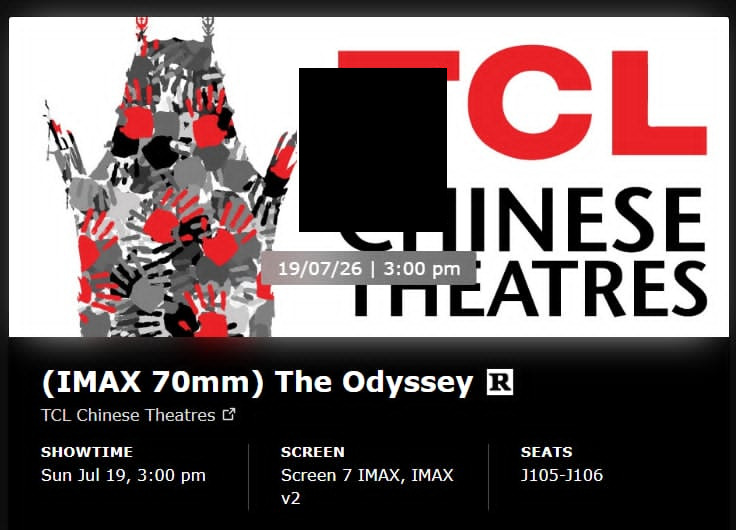
Got those Odyssey tickets...

iiazwk.jpg
 
A few weeks back I jokingly said in chat that Tenet was a bad movie and that I enjoyed it like I enjoy watching The Room. That was true! I laughed my way through it the first time, and I did actually enjoy it for that reason.

But since then I've drunk-watched Tenet twice, and I think I actually like it, not just ironically. I laughed at the fumbling tumble fight in the hallway, but now I think it's cool.


Aazealh asked me what changed. Well, instead of trying to sort out in my brain what's happening on screen, I just let it wash over me. And once you've seen it a few times, you're less focused on the causation, so it naturally becomes a more enjoyable experience. I also think I initially took for granted the challenge level of trying to portray action that's forwards and backwards simultaneously. So now i appreciate its execution more, even if it often looks a little goofy.

Naturally, I still have issues. I feel like Nolan had a cool concept that he tried to figure out on screen, and the story and words came later. As a result, the dialogue is still bad. John David Washington was miscast, and pretty much shits the bed as the lead. The backwards driving car that's chasing them... that still looks and feels dumb. But the movie is good enough that it can absorb these hits.

Memento has remained one of my favorite movies in part because I feel it gets better the more times you've seen it. Once you're attuned to the structure, you realize it's been telling you all sorts of things if you'd been paying attention. This is a big factor in what I love about Gene Wolfe's books. You can enjoy them on the first reading, but the second and third offers you new perspectives, once you've been on the journey before. It's pretty rare for stories to have that much to say.

Anyway, that change of heart had me rethinking how I felt about Nolan, since prior to this, Tenet was just one more piece of evidence that latter-day Nolan wasn't for me. So here are my personal rankings:
  1. Memento
  2. Prestige — probably Nolan's "actual best movie"
  3. Tenet
  4. Inception — full disclosure: I'd place this lower, but I value my life
  5. Interstellar
  6. Oppenheimer — a spectacle, but still limited by the trappings of being a biopic
  7. Dunkirk
  8. Insomnia — I should revisit this one. I really didn't like it at the time because I'd already seen the Norwegian original, which felt dramatically superior.
  9. Dark Knight Trilogy — ill always rank costumed superhero movies lower than original movies
  10. The Odyssey Trailer

Have you seen Following? It's actually really good! I'd probably rank it after Memento and Prestige. My ranking is probably close to yours, although I haven't seen Oppenheimer (really not a fan of biopics) or Insomnia. I will be seeing the Odyssey though. More out of curiosity than eagerness. The cast raises an eyebrow. But I've been wrong before so who knows :shrug:
 
Last edited:
I saw Backrooms last night, and I was honestly pretty disappointed. It didn’t feel like a horror movie to me. It’s more a surreal movie with a few jump scares. I was probably supposed to be weirded out by the never-ending backrooms structure, but that concept is just so old to me. Probably just not for me right?

I think the fundamental issue is that the concept itself is quite thin. It isn’t rich enough to maintain interest through a whole movie. As a result, I had expected curveballs that never came. And it never did what great sci-fi does—lull you into a state of understanding, but then throw you off balance by expanding the scope and introducing new puzzles that you can’t immediately solve, leaving you to wonder between every scene before the resolution falls into place. I love that feeling! But I was following along just fine with what was happening on the screen, and I had my own guesses, which played out predictably by the end.

I don’t know… the whole thing just felt like a waste of my time. Maybe I should have just seen Obsession?
 
I saw Backrooms last night, and I was honestly pretty disappointed. It didn’t feel like a horror movie to me. It’s more a surreal movie with a few jump scares. I was probably supposed to be weirded out by the never-ending backrooms structure, but that concept is just so old to me. Probably just not for me right?

Man that's a real bummer because the trailer had made it feel like there'd be something to it.
 
I don’t know… the whole thing just felt like a waste of my time. Maybe I should have just seen Obsession?
I share your sentiment with that movie. When I said "I totally didn't get it" I meant exactly that: What and why did I just watch?
 
Since I'd already seen Obsession and there isn't much else playing in theaters (I'm not going to subject myself to watching Toy Story 5 when it should have ended with 2 or 3), I watched Supergirl. The best part was the air conditioning. It’s not bad enough to justify the absolute flop and the online hate (it is bad, just not that bad), but aside from having a small target audience from the moment they decided to make a movie about Supergirl, they made every possible decision to further narrow that audience. It’s too “kid-friendly” for people who like their capeshit darker, but it’s too dark & off-putting to families to be appealing to the general audience. For example. On the one hand, the villains are alien slave-trading pedophiles that want Kara's Ellie... I mean, Luara... I mean, whatever her name was to help "repopulate their planet" and a little girl is murdered on screen; on the other hand, the fight scenes are the usual: weightless CGI, no blood. And the themes aren’t really explored. The flashbacks to Kara’s time on Krypton before its destruction are almost effective… almost… and then her landing consists of her wondering why Superman is wearing his underwear over his clothes while Superman rambles on because they don’t speak the same language.

It has zero clue what it wants to be.
 
I enjoyed Nolan’s Odyssey. It’s a huge spectacle, but unfortunately it does lack much of the wit of the original poem. There are some witty character interactions here and there, though. And there is a purpose behind all the moodiness: Nolan’s thesis is that society is not a default, and that should scare us. Civility is neither guaranteed nor natural, it's a contract. The death of hospitality is exactly equal to the death of civilization. One act of savagery, and a collective consent around it that frames the violence as heroism, is enough to unravel it all.

I don’t mind the Hollywood dialogue. Most every adaptation of a written work loses this on the big screen. (Not excusing it!)

Telemachus’s journey in this picture feels slightly aimless and pointless. A ball was most definitely dropped here, though Tom Holland does an alright job. I guess we’re talking about acting now: Matt Damon is fantastic and completely bodies this take on Odysseus, for what it's worth.

A lot of the plot structure of this picture is borrowed from Oppenheimer, you've got the meat of the story in Odysseus' perils, followed by nearly an hour exploring its consequences. The journey itself is breathtaking, akin to a series of consecutive dream sequences, for better or worse. But I think the second part may be my favorite, and that’s saying something.

I am happy to report that the theme of hospitality remains central, although the simplified dialogue often makes this theme trip over itself. Odysseus’s actions at the end will most likely feel random to anyone unfamiliar with the poem. He does kill most of the suitors here; the problem is that the movie makes it harder to grasp why. They have not merely insulted him or coveted his throne. They have violated the reciprocal law that allows society to exist at all. Once hospitality dies, civilization dies with it. This is the film's most clear message.

And worry not, Odysseus doesn’t hate or defy the gods randomly. Moments like cutting the head from Athena’s idol in Troy are ultimately reframed through regret. I do like that reframing. Homer’s Odysseus is still prepared to answer blood with more blood when the suitors’ families come for him, and Athena has to order him to stop. Nolan’s Odysseus instead knows what he did and prefers to face the music: he gives the throne to Telemachus and leaves with Penelope to atone rather than conquer.

Still, I find the biggest flaw to be a lack of whimsy. I would've liked to see out-there beats like the meetings between gods (Are you a coward Nolan!?). The environments are breathtaking, but ultimately grounded, could've used some color. And there's some editing issues in the first 20 minutes or so, very rushed pacing. I'm assuming this was done to make shooting in IMAX 70mm possible, as the runtime had to be under three hours.

As far as Nolan goes, I still have to think where I'd rank this in his filmography. But I definitely like Interstellar and Oppenheimer better, those remain my favorites from him.

It’s definitely a very different Odyssey, one informed by recent atrocities of our modern times, and genies released from lead bottles (Again, like Oppenheimer). You may think that's cringe, fine. It works for me alright. Still, the film uses the metatextual element of being based on a 3000 year old poem to convey that present will too become an old story someday, and perhaps we may survive to sing it. Perhaps.

"To burn the walls of Troy was to burn the world entire."

P.D.: I am familiar with Samuel Butler's translation of the poem.
 
Last edited:
I finally saw Sicario. I'm not sure what took me so long, but I really enjoyed it. I don't particularly care about Villeneuve, but he nailed this one. It's beautifully shot, with lots of atmosphere in every scene. It also reminded me that Benicio Del Toro is entertaining on screen, no matter what he's in—even the sequel, which was... whew... they really shouldn't have bothered with that one. It felt "direct-to-streaming" before that was even a thing.
 
On the Spider-Man: the Brand New Day... (Spoilers, duh)

Aristotle imagined an unmoved mover: a first cause that sets everything else in motion without itself being moved. Spider-Man: Brand New Day is not boring in the conventional sense. Things are always moving. Mysteries staged, powers mutated, relationships rekindled, recognizable faces wander in from other corners of the Marvel Cinematic Universe. One scene sets another in motion, which sets another in motion after that, until the film begins to resemble a vast mechanism whose parts have been turning so long that nobody remembers what first compelled them to. There is plot, momentum and expenditure of energy everywhere, yet movement alone is not evidence of life. A machine can run an entire sequence, transferring force from one component to the next gradually exhausting itself without ever possessing a will, a consciousness or a purpose of its own.

There is no central dramatic idea binding it together, no governing visual sensibility, and no clear understanding of what this particular Spider-Man story is about. The result does not feel directed so much as negotiated. I hesitate to place all of that at the feet of Destin Daniel Cretton because the movie, rarely, feels like the product of a director being allowed to pursue a singular vision. It feels cowardly: constantly turning toward the audience to make sure it has done justice to the Spidermensch, 'the desired Spider-Man' of online fandom in the year 2026, sure to change following this release, as it always does. In that respect, it recalls The Rise of Skywalker, another blockbuster so frightened of disappointing its audience that it reduced itself to a frantic inventory of things the audience might recognize.

Tom Holland remains a good Spidey, it’s an aside by now, that has never been the problem. He can still communicate Peter’s anxiety and emotional baggage even when the writing reduces those qualities to exposition. Holland has an instinctive sincerity that prevents Peter from becoming insufferable, and his chemistry with Zendaya remains visible whenever the movie allows the two of them to occupy the same scene without immediately burying them under the mechanics of plot.

The Punisher is funny, too. His straight man to Peter produces some of the film’s more natural humor, partly because the contrast between them is so immediately legible. Peter believes that every life can be saved, while Frank Castle approaches each situation as though the most efficient solution is an assault rifle. Their interactions have an energy that much of the movie lacks.

But being amusing does not answer a more important question: why is the Punisher in this story?

That question hangs over nearly every supporting character and accumulates. Bruce Banner appears to provide Peter with advice about suppressing his mutations and then repeats the familiar routine of not wanting to become the Hulk (before inevitably becoming the Hulk). Yelena Thunderbolts arrives to deliver exposition, briefly reminding us of another Marvel project before disappearing again. Frank becomes involved because the screenplay wants an edgier counterpoint to Peter, but his presence does not meaningfully deepen the film’s themes. Even Jean Grey, ostensibly the central new character, often feels less like a person than another asset of an imported collection.

The action ranges from decent to mediocre, sometimes within the same sequence. If I'm being honest, I found Jon Watts' direction led to more effective action in No Way Home. There are images that work. A passage shown from Spider-Man’s point of view briefly restores the exhilaration of swinging through New York. The sequence in which Peter’s organic webbing spreads uncontrollably through the prison has the chaotic inventiveness one expects from a Spider-Man movie. Scorpion’s (brief) scenes understand that action becomes exciting when bodies and objects appear to possess mass. Elsewhere, the illusion collapses.

Spider-Man’s digital body is thrown across environments without any convincing weight. His limbs move like a rendered model being dragged between coordinates, and I frequently could not persuade myself that a human being was supposed to be inside the suit. The green-screen work is not merely noticeable but, in several scenes, unacceptable for a production of this size, even when the bar set by recent MCU outings is so low. Characters appear separated from the environments they inhabit, lit according to different physical realities.

A shot of the Punisher firing toward the camera looks like something from a Steven Seagal direct-to-video action film. The confrontation with the Hand, which should serve as one of the film’s great releases of energy, instead resembles a weightless video-game map populated by disposable targets.

This problem extends beyond the effects. New York is depicted as a perpetually cloudy, dreary non-place. The city has little texture, color or social life. It is difficult to understand how a film about Spider-Man could make New York feel so anonymous.

The movement consistently lacks dynamism. There are an extraordinary number of scenes in which Spider-Man stands around in his full suit, just talking. That image can be funny, strange or even poignant when a filmmaker recognizes its inherent absurdity. Spider-Man 2 turns an elevator ride into a joke precisely because it understands how ridiculous a silent superhero looks when forced into an ordinary social situation.

Here, the same image is presented without wit. Spider-Man stands. Spider-Man talks. Spider-Man listens to exposition. The compositions are dull, the blocking is awkward, and the costume becomes visually inert. There’s certainly quips in this flick, as you’d expect, but it has no overarching comic perspective.

That distinction matters. Wit is not merely the presence of jokes. It is a way of seeing the world. The Raimi films understood that Peter’s misery could be sad and funny at the same time. A romantic defeat could be genuinely sad while also becoming another indignity in an endless chain of humiliations. Here, every disappointment is presented with suffocating seriousness. When Peter sees MJ with another guy, the film does not trust the situation to sting on its own. It stretches the moment into a prolonged performance of devastation.

This melodrama often feel curated to survive outside the movie. Dramatic glances, vague statements, blocks of Peter and MJ, of Peter and Jean, arrive with the polished emptiness of material designed for edits on TikTok. They can be detached, set to music and circulated as evidence of emotional depth. To be grown beyond by fandom than what they actually are inside this movie. Within the actual story, they rarely accumulate into anything.

Brand New Day attempts to juggle three major strands: Peter’s reunion with MJ and Ned after No Way Home; the emergence of his enhanced spider abilities; and Jean Grey’s struggle with grief and self-acceptance.

These should not be three separate stories. A coherent screenplay would make each strand illuminate the others. Peter’s fear of reconnecting with MJ could relate to Jean’s fear of opening her mind to other people. His changing body could deepen his anxiety about whether there is still a stable “Peter Parker” beneath Spider-Man. Jean’s rage over the loss of her sister could force Peter to reconsider the ways he has processed the loss of Aunt May. The government’s attempt to suppress Jean’s gift could mirror Peter’s attempt to suppress his own evolving abilities. The connections are sitting there, but the film does almost nothing with them.

Instead, it progresses through the three strands sequentially, shifting emphasis whenever the plot requires a new source of conflict. First Peter’s powers become a problem. Then his relationship with MJ becomes the emotional focus. Then Jean’s history with the Department of Damage Control takes over. Instead of converging, the storylines take turns occupying the movie.

This makes it difficult to identify the film’s center. What is Brand New Day actually about? Is it about Peter accepting that he cannot live in isolation? Is it about accepting physical change? Is it about grief? Institutional violence? The moral limits of revenge? The danger of suppressing one’s authentic nature? The film gestures toward every one of these ideas and commits to none of them.

The organic-web storyline is the clearest example. Peter wakes with heightened senses, new physical abilities and webs emerging from his wrists. His senses overwhelm him. His eyes darken. He becomes unusually violent toward Scorpion. He constructs an inhibitor because he fears losing control.

The inhibitor creates an obvious parallel with Bruce Banner, which explains Banner’s inclusion at the level of plot utility. But the comparison never develops. Bruce has spent years fearing the part of himself he cannot control. Peter has spent years defining himself through a power that is inseparable from his body. Their experiences with suppression, identity and violence should produce a meaningful conversation, instead only leading to cold, scientific, jargon. The film imports a character with decades of thematic synergy and uses him as a tutorial.

If the mutation plot is theoretically transformative but dramatically inconsequential, the MJ and Ned storyline has the reverse problem. Its emotions matter, but its destination is never in doubt.

The initial deception involving Jean assuming MJ’s identity is effective. For a moment, the movie weaponizes Peter’s longing against him. Because he wants MJ to remember him so badly, he becomes vulnerable to an imitation of the connection he has lost. It is one of the few places where the external superhero plot and Peter’s internals meaningfully intersect.

Once this deception is revealed, however, the relationship proceeds along the expected route. MJ is wary of him as a stranger. She learns more about Peter. They spend time together. A connection begins to reform. Ned is gradually brought back into his orbit. By the end, Peter has begun rebuilding the relationships that No Way Home took away.

The movie spends an enormous amount of time undoing the previous film’s ending so that these characters can return to something resembling their old dynamic. It presents this restoration as progress.

That choice exposes the hollowness of the “brand new day.” Peter’s isolation is not treated as the foundation of a genuinely different life. It is treated as merely an obstacle separating him from the familiar supporting cast.

There is little sense of Peter existing outside the plot. We do not meaningfully experience his routine or attempts to form relationships unrelated to his previous identity. The people around him remain brilliant, technologically capable young adults who can solve whatever practical problem the screenplay places in front of them. Peter still has access to advanced systems, an artificial-intelligence assistant and enough equipment to conduct mass surveillance across New York.

The film wants the iconography of the lonely, struggling Peter Parker without truly embracing the limitations that make that version of Peter compelling. It wants both them cakes.

The return of the AI assistant (not seen since Homecoming) is particularly revealing. After No Way Home stripped Peter of his institutional support, the promise of a more independent Spider-Man was that he would have to rely on his intelligence, improvisation and limited resources. Organic webbing could have reinforced this idea by giving him a power that required no expensive mechanical equipment.

Rather, the film places him in another technologically saturated environment. The webbing becomes largely irrelevant to his material circumstances, while his conspicuously framed Republic of Gamers gaming laptop turns portions of his new life into an advertisement.

More damagingly, he lacks agency within his own emotional development. Other characters frequently tell him what he is doing, what he is feeling and what he needs to learn. After he loses control and nearly kills a police officer, the bureau detective tells him that this is not who he is. The realization should belong to Peter. The scene should force him to confront his own violence. It's another character who performs the introspection for him.

That pattern persists throughout the film. Peter is the protagonist, but he is often treated as an object to be diagnosed. Information comes to him. Characters explain his moral condition to him. The plot creates a destination, and Peter is carried toward it. At one point, it's even a third party who has to throw him on the scent that he's been lied to.

Jean Grey gets an elaborate storyline here. She has lost her sister, Sara, to a corrupt government institution. She is initially presented as a dangerous telepath; the apparent authority then turns out to be hiding horrific crimes. Jean’s rage becomes understandable. The “villain” is revealed to be a traumatized victim, while the big institution is shown to be the true monster.

It is one of the most familiar reversals in modern superhero storytelling, but familiarity is not automatically a flaw. A basic story can become powerful through specificity. But Jean rarely feels specific. Her grief, anger and eventual retreat follow the standard architecture of a misunderstood antagonist without developing a distinctive psychology. Even the revelation of “V-Max”, the writing on an air vent that became Sara’s final visual impression, is less emotionally clarifying than the film seems to believe. The mystery is constructed with such unnecessary confusion that the answer lands as plot information rather than tragedy.

The mechanics of Jean’s powers are similarly unclear. Peter is supposedly uniquely capable of perceiving her movement from body to body, but the visual presentation makes the possession seem physically obvious. Hosts twitch and jump in ways that appear visible to everyone, including the audience. The film insists that Peter possesses special perception and fails to convey it.

More importantly, it’s Jean’s conflict that reveals the film’s internal incoherence.

Look, my problem is not that Spider-Man interacts or cooperates with police. That idea is not inherently objectionable. The Spider-Verse films make Miles Morales the son of a police officer and use that relationship beautifully. Jefferson is presented through degrees of fantastical and emotional abstraction, where he is not a symbol inserted to validate an institution but a father, community member and unambiguously decent person whose profession complicates his relationship with his son. Brand New Day does not create that kind of human foundation.

The non-character of NYPD detective Jean DeWolff contributes little to the main plot and exists primarily as exposition feed. As a Latino viewer, I found the film’s attempt to characterize her particularly patronizing. The objection is not that a Latin American character flaunts their heritage; it is that DeWolff drops disparate Spanish words as decorative proof of ethnicity, it does not emerge naturally. It functions as a credential, assuring the audience that she represents a particular community without requiring the screenplay to imagine her as a culturally specific person.

That superficial characterization also obscures what DeWolff represents within the film’s internal logic. Beneath the gestures toward diversity, she remains an agent of institutional authority whose primary purpose is to validate Peter and interpret his conscience for him. Her identity gives that authority a more sympathetic, ostensibly progressive face at the exact moment the story is exposing another government agency for kidnapping, torture and murder. See my problem? That is what makes the portrayal so uncomfortable. Her characterization worsens into ideological camouflage. DeWolff is made to look socially specific so that the authority she embodies can pass as morally neutral. The film condemns the Department of Damage Control while using her to reassure Peter, and audience, that institutional power itself remains fundamentally trustworthy, yet gives her no meaningful agency or narrative purpose through which she might challenge that role.

Peter’s surveillance tactics make for another disturbing contradiction. He uses a citywide camera network to track people across New York and doesn't think twice about it. Shortly thereafter, MJ criticizes “soulless” corporations and governments for abusive human rights records. The movie never reconciles these positions or even acknowledges that they conflict. It wants the imagery of resistance without examining its hero’s participation in the same systems. Now now, Nolan's Batman movies fall into a lot of these same pitfalls, and they're not perfect, but they at least acknowledges that these themes are there at all.

Jean has every reason to hate the people who imprisoned her and killed her sister. Peter is correct to prevent her from killing indiscriminately, but the film repeatedly blurs the distinction between protecting innocent people and protecting the institution responsible for her suffering. That should become the story’s central moral problem. Peter ought to ask whether his instinctive defense of order has made him an ally of injustice.

Instead, the climax shifts from politics to therapy. Peter allows Jean to enter his mind and encounter a memory of Aunt May accepting him. He offers empathy, demonstrating that grief does not have to become violence. On the most basic emotional level, the idea works. Peter reaches Jean not by overpowering her but by exposing his own pain.

Yet the scene serves to avoid the hardest questions the movie has raised. May’s love does not explain what justice for Sara should look like. Peter’s compassion does not resolve his cooperation with a corrupt agency. Before you can really think about it, Jean has left the city and the DODC is coming under investigation. What is missing here is heroism, not heroism as victory in combat, but as the willingness to take a moral position at personal cost. Peter never decisively turns against the institution that killed her sister. He does not expose it himself, secure justice for its victims or risk his standing by refusing to cooperate with it.

That leaves Spider-Man functioning less as a hero than as the manager of an unjust status quo. He restrains the victim, calms the crisis and trusts the same system that created it to correct itself. The film permits him to oppose Jean’s violence, but not to confront institutional power with comparable conviction. He saves the immediate moment without challenging the order that produced it. The film marks de-escalation as the answer.

That refusal of consequence also governs the ending. Brand New Day neither resolves the societal conflict it has raised nor meaningfully advances the larger MCU story it is supposedly helping lead toward Doomsday. After all of this motion, the question becomes not merely how the film concludes, but what, if anything, it has actually moved forward.

The answer appears to be that Brand New Day is not designed to advance anything. It is designed to sustain attention until the next release.

That philosophy is captured when Peter is shot, collapses and bleeds out with all the ceremonial gravity of a major sacrifice. The audience is invited to believe that something irreversible may finally have happened. Almost immediately, the movie reveals that he survived.

And of course he survived. This is not shocking by itself; few viewers seriously expect Spider-Man to die permanently in this film. The problem is the shamelessness with which the movie demands the emotional response anyway. It performs the imagery of consequence while relying on the audience’s willingness to accept a burst of sacrificial imagery in place of the political and moral reckoning the film has just evaded.

The emotional distance created by one of the most powerful spells in the universe begins to dissolve through an intimate gesture and familiar connection. A secret handshake apparently accomplishes what cosmic magic had declared impossible. The moment may be sweet in isolation, but it confirms that No Way Home’s ending was never a permanent transformation. It was a temporary arrangement waiting to be reversed once the sadness had generated enough value.

Jean’s departure is staged with the same strategic vagueness. The sequence never clearly establishes what she does, where she goes or what her future now means. It recalls Wanda’s apparent death at the end of Multiverse of Madness. Its ambiguity used not to deepen the tragedy, but to make things comfortable for the character’s eventual return. The film leaves every possible door open because closing them would require actual decisions for the universe.

Then the credits begin, and I was genuinely aghast at how closely they resembled a car commercial. You’ve got polished surfaces, sweeping urban imagery and, at last, a sunlit New York. It is one of the rare moments in which the city is allowed to appear bright, textured and alive. The credit sequence displays more visual confidence than much of the movie that precedes it. That sounds like an exaggeration. It is not.

The film’s visual lifelessness, confused politics, disposable cameos and disconnected themes all emerge from the same underlying problem here. It does not know what it believes. It does not know whether Peter should be independent or technologically omnipotent, whether government power should be feared or trusted, whether isolation has transformed him or merely delayed his reunion with the old cast, whether Jean’s anger is justified or simply another emotion to be therapeutically neutralized from radical change.

It wants Peter to be alone, but not so alone that familiar characters disappear. It wants him to struggle, but not so much that he loses access to extraordinary resources. It wants stakes of institutional corruption, but not a hero forced to examine his relationship with said institutions. It wants mutation, but no meaningful changes to Peter’s identity. It wants death, but not loss. It wants a brand-new day, but not a brand-new slate.

Everything the movie supposedly includes because it is “what the fans have been asking for” feels forced because desire alone is not a dramatic principle. Peter living alone is not automatically meaningful. Organic webs are not automatically meaningful. A “street-level” hero is not automatically meaningful. They are notes.

And Brand New Day is piles and piles of notes. Some from the studio, some from the cast, some from the franchise apparatus and many seemingly filtered through whatever Marvel’s online audience currently believes Spider-Man is supposed to be (Which Holland even boasted he researched and incorporated!). The movie incorporates these demands without transforming them into a unified work.

That is why blaming one director would be too easy. Jon Watts was previously treated as the central explanation for every limitation of Holland’s Spider-Man films, but the recurrence of the same problems suggests something more systemic. A director can stage the material, but staging cannot create conviction where the material has been designed by committee to avoid committing to anything.

Marvel has figured out that it can merely tease consequence and have viewers imagine it for themselves. It's the audience whom supplies the investment, the history, the emotional stakes. The movie only has to remind them that they exist and in return they'll keep the still life on the move.

Brand New Day is not the worst possible Spider-Man film. It may be something more dispiriting, a film with enough talent, money and potentially rich ideas to become meaningful, made by a system that no longer sees meaning as necessary.

It moves, for certain.

It never comes alive.
 
Last edited:
Before I saw The Odyssey, I really wondered what Nolan was intending. These characters and story beats are so well known and mapped, what's the purpose, other than recasting these scenes with a modern set of colors? Now having seen it, I get it. Nolan is pretty purposeful in what he cuts and what he keeps, because he’s making a point about the fall of Troy specifically. That’s the focal point. His take on the Odyssey hinges on that moment.

Trying to grasp my feelings after seeing it, I found they were more complicated than I expected. I never had particular interest in the Odyssey. I was always more of an Iliad guy. By the end of this movie, I was at times both thrilled and bored by it. But its last punch hits hard, and caused me to reassess it. So I'm actually going to see it again next week.

And here is where you can stop reading, if you're not into long-winded posts: This movie is worth seeing in theaters. It's loud, and the visuals take full advantage of the big screen. The scale of it is huge. I'm wiping my eyes over here in advance for the inevitable sap in the future who watches this on a plane.

Instead of a comprehensive review, I wanted to write about the three most memorable takeaways:

—Odysseus in disguise, telling Penelope why her husband may have lost his way while heading home, finally revealing to the audience what's been occupying his thoughts since his role in the fall of Troy.

The fall of Troy is held back for a big reveal toward the very end, because it's central to this version of Odysseus, and the shape of Nolan's Odyssey.

Odysseus is burdened about the crumbling of civilization that he invited by opening the gates of Troy to his invading army, by violating Zeus' Law. That burden is, in retrospect, evident in every scene, because it constrains Odysseus' range of emotions. At first I thought it was Damon being incapable of much range. It's certainly not how I had pictured Odysseus (he doesn't even come across as cunning, as he should). But seeing the ending, it feels intentionally constrained, lacking the intensity and charisma one would expect of Odysseus.

Odysseus never laughs (or if he does, it's hardly notable), he doesn't boast (as he does in the poem to Polyphemus about the war in Troy); when he takes his revenge on the suitors, it's cold blooded not white hot rage; watching his comrades get blown away by the storm, he's upset but not particularly anguished. In moments of heightened emotion like these, he's only wearing a placid or strained expression.

Weighting the cost of that thematic sense of burden over a more natural take on these scenes, and right now I feel like we got a little shortchanged by this Odysseus. I've read that people think Damon dunked this. I just tend to compare it with what I expect of an Odysseus, and he felt subdued.

—The gates of Troy finally open, and standing there waiting, like the fucking Terminator, is Agamemnon, while a legion of Greek soldiers swim around him. And he marches soullessly on, his features obscured.

Agamemnon left the largest impression on me. His portrayal draws attention to itself, so I immediately began wondering what Nolan was doing with him. I felt he was repositioning this character's arc, which makes more sense as the movie ends, and you see the cost of the war that he had been responsible for. He's portrayed primarily through his helmet and armor, which fully envelope him. It means you only rarely see glimpses of his face. Even in his flashback, when his armor is removed, he's shown from behind. The resulting portrayal is that which makes him human is obscured, minimized. He is the armor he wears, bereft of agency, like a soulless cog in the machine.

It reminded me of the tension between Odysseus and the gods, personified through "Athena"'s interactions with him. She asked him on Apollo's island—why not simply trust in the gods to provide his fate? Agamemnon seems to have entrusted everything to the gods to fuel his ambition. He sacrificed his daughter for fair winds to Troy, and as Odysseus says, the power of a sacrifice is measured in what it cost the person (none of which is in the Odyssey by the way, that's a flourish from another, later work about Agamemnon). Just then, I couldn't help but think about the God Hand. How their power starts with sacrificing enough to sever their humanity, and shed their final tear.

Agamemnon wears a golden spinal column in his headdress, as if commentary on the humanity that's been stripped away. But I realized it's more than that. It was his sacrifice. It's the spine of his daughter—that's why it's small. He gave up so much to achieve victory, and in the end, he was killed for what he gave up.

I'm out on a limb here, but I started wondering if this juxtaposition holds up—Agamemnon on one side, the suitors on the other, and Odysseus in the middle, it tells a kind of story. The suitors, and Antinous in particular, mock the gods' customs and pay for it. Agamemnon surrenders everything to them and becomes a hollow monument, ultimately betrayed. Odysseus, who often defies the gods and pays, has to find a way to survive and remain human to assure the future of his family and of civilization.

—Polyphemus lifting and munching on a body, an arm dripping from his mouth. His pale skin and the texture of it, the rearranged features making it uncomfortable to focus on his face, his body not disproportionate from a human's, but simply larger, more menacing, and yet also worthy of pity.

When I first heard Nolan was adapting The Odyssey, this scene immediately came to my mind, and I wondered how he would achieve it and not make it corny. Movie audiences these days have seen a giant or two. So how do you do it in a way that surprises, horrifies, today's moviegoers while still being consistent with a very grounded approach to fantasy? Well somehow he did it, folks.

Polyphemus' scene is effective through a combination of practical effects, lighting, design, and sound effects all working together. I don't know if it was the most difficult scene the crew filmed, but it sure looked like it to me. Polyphemus looks like a Guillermo del Toro creature (he's not). The contorted features are uncomfortable to look at (in the same way your mind wants to complete a picture, seeing the features distorted is uncanny, discomforting). But the design also elicits sympathy after Odysseus' crew attacks him. How'd they manage that? I don't know.

Thoughts on the Cast:
Matt Damon as Odysseus Odyssey:
Matt Damon in his least Matt Damon role ever. I could actually tell he put effort into this one! I think he'll end up with a lot of credit for carrying this movie. But I felt he was too even keeled for Odysseus. Didn't lean into the role enough, in my opinion. Maybe not allowed to, because of the thematic constraints of his character? I bet he'll get an Oscar nomination for it, anyhow.

Anne Hathaway as Penelope Odyssey:
An accomplished actor. The through line for Penelope is that she's at her breaking point, being fed up with waiting for 20 years. She's had enough. My issue with her portrayal is that in those moments of instability, she squeaks in a childish way that was scene-breaking for me. I also feel a little bad for her, because there are many scenes where she has to act through a screen, obscured, so she had to dial up her reactions a bit.

Tom Spider-man as Petros Parkos:
This role could have been filled by absolutely any other actor. He gave a really wooden performance. His role is truncated to mostly serve as the window for the audience, asking all the right questions, trying to discover who his father is. He's just not given very much to do (go here, listen to this guy, then come back and listen to your dad; react).

Benny Safdie as Agamemnon Godhand:
I absolutely wasn't expecting this at all, but I found his portrayal fascinating. He's a very stripped down, almost robotic character. When the guy is on screen, he moves like he's Robocop, which makes your mind go in a certain direction about this version of the character. I loved it.

Robert Pattinson as Antinous Scumbag:
Really deft performance throughout, appropriately slick and oily. But he was made almost cartoonish and pathetic by the end. I felt he could have been given a bit more dimension.
 
Last edited:
So umm, I recently watched the Indian film Ramayana: Part 1, produced by Namit Malhotra, the Indian business who effectively owns DNEG, the Oscar winning studio known for its cgi and vfx and directed by Nitesh Tiwari, a highly acclaimed Indian director, best known for directing, Dangal, the highest grossing indian movie of all time, whilst also boasting a humongous budget of 400-500mil, making it the most expensive Indian film ever.

The franchise attempts to adapt the legendary Indian epic Ramayana to the big screen, effectively the greatest attempt made to make the story reach a truly global scale in form of a duology...However, It's a slop. Its an incredibly boring, lifeless and unmotivated piece of crap imaginable. The fact that this was a "passion project" for Namit is an insult to the term passion project as passion is clearly missing.
Even a child in his nappies who has heard this story from his mother would present Ramayana much better than this movie ever would.

Even if we grant them all the creative liberties to deviate from the source material(s), even just purely as a fantasy film, it's straight up buns. Its riddled with ridiculously incompetent and inconsistent writing with garbage pacing, lame dialogues, mediocre action, terrible worldbuilding and an abhorrent Hero-Villain dynamic.

Anyone who has atleast some familiarity with Ramayana knows that this is not a text made for mere enjoyment but rather a deep religious text whilst also containing a relatively interesting story. A bit of a fun fact but Ramayana is the first poem written in classical Sanskrit, penned by Sage Valmiki.
Even if one had to adapt the text to a movie, it needed to be atleast a trilogy than a duology.
Its borderline unacceptable that there exists people who think Ramayana could function as a duology because it simply cant, especially if you want your franchise to be a global starter point for people all around the world to the text AND Hinduism. Just for reference to show how huge Ramayana is, It's nearly double in length of both Iliad and Odyssey combined.

I would like to give a bit of an extremely succinct overview on importance of Ramayana and why it's a text that is important to India.
Ramayana is the ultimate story that represents Indian civilization(I don't know what the story to represent all the story would be for your country or Western civilization) but it is Ramayana that represents India. Rama is the crux, he's the ultimate figurehead of the entire nation's history. His name literally translates to "the one who pleases", both from kings trying to fit them in the lineage of Rama to poets dedicating poems to him because of how pleasing and great his character is to even non Hindu religions fitting Rama to their scriptures(Jains have their own version of Ramayana, Buddhist texts have reverence for Rama as well and so does Sikhs).
What makes Ramayana a dear story is Rama and everything that happens, be it happy or sad, is about Rama. He's the soul of the story. Ravana, the main villain, is nothing but a mere demon Rama has to slay. He is not the entirety of Rama's life, even though one of the main reasons why Lord Vishnu took an incarnation was to save the three worlds from Ravana.(Key word here is "one of the", it's not the sole reason and even after Ravana is slain, Rama continues to live for another good eleven thousand years).
Valmiki Ramayana starts with Sage Valmiki as he asks Sage Narada on a perfect man and Narada narrates the glory of Rama. (Valmiki is actually contemporary to times of Rama in the text making the epic a contemporary "biography" in some sense. Although, Valmiki did not know the events of Rama and his battle with Ravana). Then Valmiki pens down Rama's story in a linear fashion, starting from his birth to his marriage with Sita and then his exile to Sita's kidnapping and then him making a monkey(another note is that the sanskrit word used to describe is vanara which is moreso a divine beings of their own. More modern interpretation interprets them as some sort of tribes but that's kinda nonsense) and meeting with Hanumana, another really important Hindu god and then the eventual battle where Ravana is defeated and Rama's exile ends and he returns back and is coronated as the king.

The movie instead, tries to build a dichotomy. A parallel dynamic between a demon and a god's avatar. A demon who isn't exactly a mustache twirling bad guy but rather evil with some shades of redeeming quality, who came from nothing and became this egotistical maniac...the thing is, Ramayana would never work on it.

The movie starts with a sequence with Devas(the good guys or the gods) oppressing the Asuras(the demons) and Ravana is some sort of liberator for them as he gains his book from the Creation God, Brahma(where no god could slay him). This allows him to quickly become ruler of the three realm but... This is a bastardized interpretation of Devas/Asuras dynamic present in scriptures. Asuras were not tormented and Indra, the god of Devas(the Indian version of Thor/Zeus) isn't some sort of tyrannical oppressor.
Asuras are the troublemakers whereas Devas reprimand them. Usually, Indra is enough to slay them but sometimes, the Asuras is granted boon to make themselves invincible against Indra, prompting the bigger supreme entities like Vishnu to step in.

This sort of dynamic presented where Ravana is a liberator of Asuras from Devas is fundamentally a very grave mistake. Ravana IS a mustache twirling villain who had ZERO redeeming qualities as a person. He was a great warrior, sure but had zero redeeming qualities. He was a serial rapist, a genocidal maniac(much like ganishka ffs).
The movie brushes basically everything bad about Ravana to shadows. It doesn't overtly glorify him but it shys away from addressing his bad side.

The timeline with how his rule begins is clunky as his expedition are covered in a song montage. So you know in berserk how Miura pulled that "despair" feeling where the world was so fucked up in conviction arc, making Femto come down literally?
The movie doesn't justify or makes an honest earnest attempt to make the reason for Vishnu to take an avatar, simply because of how garbage the pacing is.

Even Ravana's expedition to Swarga(which translates to heaven but that's not really appropriate and Indra's defeat) is clunky. Its not exactly a loss yet it feels like it. Because in the original text, Indra clapped Ravana hard. He couldn't kill him but Indra beat the fuck out of him(think of how ganishka used his lightning to fry down Guts). But Ravana's son, Meghnad interfered and using his wicked illusionary powers, captured Indra. This scene is completely absent from the battle and all you can see is Ravan "aurafarming"...yea sure.

Too much emphasis on Ravana "aura" absolutely ruins and creates plotholes.

Now, because they try to forge a fake ass rivalry between Ravana and Rama.
Everything that happens to Rama in the movie feel like a clueless filler. Much of his childhood expedition and mini short episodes giving glimpses of his lineage is entirely cut, to accomodate and progress the first half of the story.

Because see, what they did was...they built Rama vs Ravana yet you see Rama slaying some random monster that is not related to Ravana. Its a forced parallel that is made. Ravana never stood a chance against Rama at all yet the movie wants to hype as such.

This leads me to Rama's characterization. Its not the problem of this film but rather what Indian gods were and what they are now. During times of colonial empires, Indian gods changed. Their iconography changed where Vishnu was meant to be a dark complexioned deity changed to a sky blue colored God. You can check out St. Xavier's letters and writings where he notes on how the icons looked and how Indians were actually obsessed with dark skin so that they can look like their gods. Sadly, with years of inferiority complex, gods became fairer.
A TV series on Ramayana was launched in 1980s which was so popular in India that it's practically the starting entry of an entire generation. And the TV series is equally responsible for bastardizing rama where the main actor who played, Rama looked like an average 40 year old Indian man with some fucking dad bod and zero muscles put.
More emphasis was put on Rama's gentle nature which completely stripped him of personality and valor.

This movie is same. Rama is a regal and accomplished warrior with a martial pride while also adhering to righteous conduct i.e. dharma(he's in some sense, the literal embodiment of dharma). He is a gentle giant in design. Think of Guts and Griffith combined. Rama has the gracefulness and youthful appearance of Griffith and the powerhouse unit physical features of Guts. These two [ https://i.imgur.com/hVDSiTp.jpeg ] AND [IMG2] are somewhat good visualization of what is described. Not accurate but good.

The main actor who plays Rama retains none of such features. He has zero features that make him stand out. He isn't royal, he isn't exceptionally strong, he isn't exceptionally charming. And the final is actually important. Just like how Griffith enchanted people with his presence, Vishnu is actually the same(obviously not the evil part lol).


Lakshman is a blatant boring witty sidekick in this film. In the text, he's the incarnation of Anant Shesha(the snake on which Vishnu sleeps ). Hes exceptionally loyal to Rama throughout the story. In the movie, he is loyal don't get me wrong but the intensity, holy fuck is missing.

The movie tries to make a dynamic between the two brothers where Lakshmana cracks joke but guess what? Rama doesn't reciprocate making the entire dynamic a forced cliche. Whereas in the original text, Rama is full of personality. He jokes, preaches, full of personality. In here he's just a fucking boring slop with a cardboard personality.

To glorify Ravana and hype him, they actually make Rama and Lakshmana as underdog of sorts. Their valour is not at all displayed. The mere presence of their name made demons shit their pants and in the movie they're running away from these demons. Sure they are killing them but you literally just nerfed the brothers for no reason...like why? To hype the main villain...oh my lord this is pissing me off.

In the original text, Rama actually enjoyed hunting demons but here, there's no such case.
A lot of Rama's fights are kind of like Guts' fight against apostles. Extremely bloody(but they're one sided) and full of action, hype and badassery. Guess what? Nothing in this movie. *Claps*

Sita's portrayal is garbage. She's shown to be exceptionally competent because duh...a female character should always be a strong independent women. She's shown to be competent in fighting with weapons. I have no problem with that but it's what it's used for narratively.

Before that, I would also like to bring the Surpnakha incident. In the original text, Surpnakha is a female demon who fell in love with Rama. Rama brushes it off and jokes about how Lakshmana is single. Lakshmana rejects. Surpnakha, now pissed, attacks sita to murder her. Rama *orders* Lakshmana to cut her nose off.
Surpnakha escapes crying. And then she demands a revenge from her brothers. They come with 14k army of demons. Rama single handedly destroys them. He's all bloodied, pumped up. Sita after that incident, is a happy wife celebrating her husband's badass victory. Think of it like Guts slaying apostles. Its cool shit, right? Yes ofcourse it is.

In the movie, Surpnakha visits twice. First is a general meeting where she falls in love and Sita says that she has fallen for Rama. Like what the fuck? Which wife says that to her husband?
Then on the second meeting, Surpnakha assumes form of Sita and actually tricks Rama...excuse me? The entire Valmiki Ramayana's second half is filled with how Rama is depressed over Sita. He loved Sita more than anything else, uttering the line "Without you, I don't even need Heaven(swarga)". There was an incident in another retelling of Ramayana where a goddess assumes form of Sita to test Rama(she was skeptical how a god like Rama was sad over Sita) and Rama realized it instantly she's not Sita.
You're telling me they fucking blundered the emotional breakdown of Rama and made him get caught in illusion of a petty demon...sure ig.
How the 14k battle plays in movie is laughable. Rama fights for some time, then escapes with Lakshmana and Sita where the latter duo helps him. But then they're cornered and it's all sad that Rama is screwed now. And then Rama uses his best move yet wiping the army but that's terrible.
It just strips Rama of his valour and martial skills. Its just an insult. Think of the 14k battle as Guts fighting against apostles. Extremely bloody, badass but instead of our protagonist facing trouble, Rama doesn't. This one, his brother and wife helps him to fight...and when hes cornered and can't protect them...he uses his divine bow and arrow.
This guy is god's incarnation as a Prince and they can't even show him have badass wins.

Surpnakha, then calls for help to Ravana. Ravana doesn't give a jackshit about her revenge but then Surpnakha seduces Ravana with description of Sita. Ravana in lust, pulls the kidnapping in Valmiki Ramayana with his motivation being to make Sita her mistress.

Ravana is fundamentally misconstrued in the movie. His "bad side", his oppression to devas, humans is so conveniently brushed aside and his sexual crimes aren't even touched! Imagine a berserk adaptation where they don't even adapt eclipse and adds stuff to Femto post rebirth and how he "liberated" people from ganishka and the only thing new watchers know is that, yea he sacrificed guts and co to achieve god like powers, he isn't that *bad*. How would that be?


Now, Surpnakha was a demoness. She wanted to have Rama as her husband. Rama jokingly brushed her off and then told her to approach Lakshmana as a joke. Lakshmana denies. Surpnakha pissed, assumes her true ugly demonic form and tries to kill Sita.
In the original text, Rama orders Lakshmana to cut the demoness' nose and ears off.

Guess what they do in the movie? Rama remains silent as Lakshmana cut her nose and then Sita scolds Lakshmana for cutting the demoness' nose...am not even kidding.
And then when the 14k demons attack, Rama actually apologizes to the demons like what the fuck is this weak ass, submissive guy meant to be fucking god's incarnation in this garbage film?


From an adaptation POV, there are certain scenes you cannot skip. For berserk, such scenes maybe the Bonfire of Dreams segment in Golden age arc. Or the beach episode in Millenium Falcon arc. If you do them, you have committed a severe sin that just makes your adaptation of Berserk an absolute garbage.

In Ramayana, one of the most emotional scenes is Bharat and Rama union after his exile. A bit of lore- Kaikeyi, one of the three queens of Dashratha i.e. Rama's stepmother used her 2 promises[that Dashratha promised to her long time ago] night before coronation to exile Rama and make her son, Bharat the King. When Bharat got to know this wicked plan, Bharat lashed out on her mother as he was dedicated to his brother, Rama to rule and had no malicious intent of winning the throne over Rama.
Meanwhile,Dashratha died in absence of Rama.
Bharat travelled to the place where Rama was stayin in the forest.

The sequence of Bharat getting to know that and lashing out on his mother to forge such a malicious plan is COMPLETELY OFF SCREENED.


Next up is Sita's kidnapping. So they showed Sita as a warrior, right? So when she's kidnapped? Atleast she will resist, try to fight back, cry? No, she's mute throughout with a wooden experience from the actress.

Rama and Lakshmana also had a mini Pokemon esque episodic adventure in ramayana where they would travel to places, get to know the lore of that place and stuff. All these stuffs are also cut off which kind of makes sense because of how big the lore is but still worthwhile mention given how boring and lazy they were to worldbuilding.


Now, music. AR Rehman and Hans Zimmer seems to be pretty stacked up resume, right alongside infinite budget to get all the great Indian singers?
It falls flat.
Its boring. The music is also doing heavy lifting to make events feel more emotional and tragic and dramatic but the writing is so amateur, it inevitably going to feel soulless.

Its a bit of me rant but when you have ramayana and have no devotional song or mention of tulsidas Ramcharitmanas is another blunder. Tulsidas' works changed the cultural landscape of North India making Rama's story accessible to everyone in vernacular language and a lot of his writings and poems are staple in worship places yet any songs that they have released for this movie are boring or the writing of the song is as good as the writing quality shown in the berserk's continuation, if not worse.


So, everything's garbage. Atleast it must look good right? The answer is NO. The action scenes, the scenery, the aesthetics are all boring. I personally don't have big problem with the cgi and vfx as im not an expert in that field but it's nothing new. Its not like some "demon slayer where i can recommend you the series because of how good the art is."


So, Final verdict- Don't watch it.

@Lawliet, I finally finished writing this. Let me know how is it! And pardon the grammatical mistakes. I wrote it on my phone.:troll:
 
Last edited:
Back
Top