Nickoten said:
As for the war wheel name, I only called them War Wheels because that was Silat's name for thme.
Replying to that a bit late, just to say that Silat actually calls them "Chakram", there's furigana besides the war/battle wheel kanji.
TheSkyTraveller said:
You're right, the sword/whip is of Indian origin.
Hehe, I didn't think there was any doubt about all these weapons (Katar, Chakram, etc) being of Indian origins actually, they're all pretty characteristic of Indian weaponry...
Since we're at it, you guys should know that pretty much all of what we see from the Kushans in Berserk is inspired from Indian warfare, that includes things ranging from
Talwars (swords), lances and various other "exotic" weapons (
Katar /
"Fish spine" or "Shark teeth" sword (not sure which it is) /
"Fakir horns"),
shields,
armors (including helmets, gauntlets and greaves) and
horse's armors, elephant's equipment, and even the
specific Daka weapons and armors.
Zodd's sword isn't an exception (from Nepal). We didn't see any Kriss or Khukuri yet but I wouldn't be surprised if some appeared later on.
The bold parts link to a few pictures (non exhaustive of course, it would take me too much time to sort everything out).
TheSkyTraveller said:
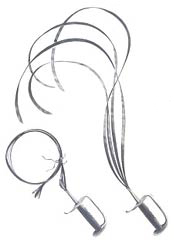
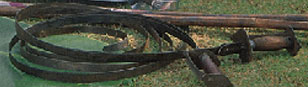
I think it's more like a sword than a whip, the metal is just pounded so thin that it's really flexible. According to a museum curator in India, the sword could also be worn around the waist like a belt, just like Silat wears it.
The name is
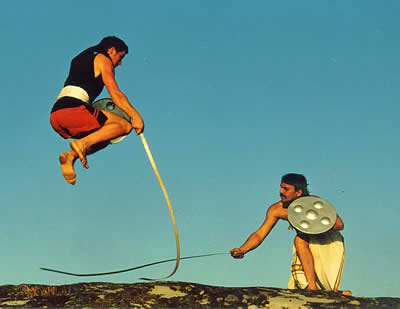
Urumi (also known as "Chuttuval", or "Spring sword", but less used). It was indeed worn around the waist (quite convenient), and yes, the "blades" are made of extremely thin, razor sharp metal. There can be from 1 to 5 blades, and their length vary from 1.5 to 2.75 meters (~5ft to 9ft), the most common way to craft it is to measure the distance from the fingertips of the future user with his arms extended in opposite ways. A blade's width usually ranges from 2 to 5 centimeters (~1 to 2 inches).
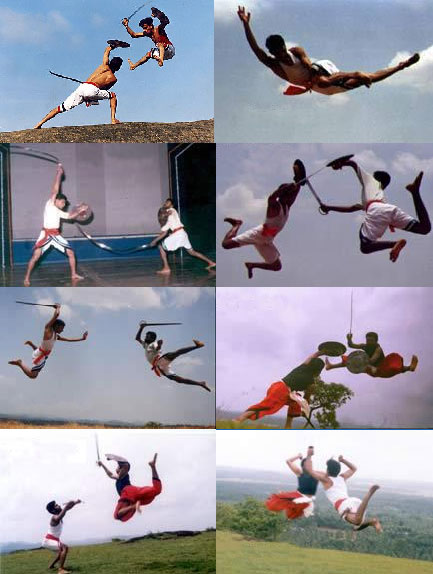
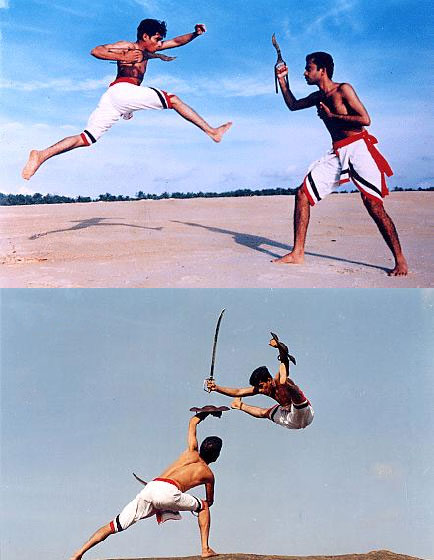
It's the ultimate and most dangerous weapon of the Kalaripayatt, an Indian martial art at least 3000 years old (most probably the oldest, it is said than Shaolin monks were heavily inspired by it), born in the region of Kerala (supposedly at the same time than the region itself). The Kalaripayatt is a highly spiritual martial art and requires extreme body flexibility. It's also vastly based on weapons (the Urumi being the final stage before the unarmed combat, that focuses on attacking the famous "pressure points" of the body). Various members of the Bakiraka clan present interesting traits that could relate to it.
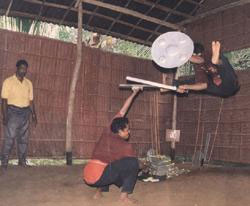
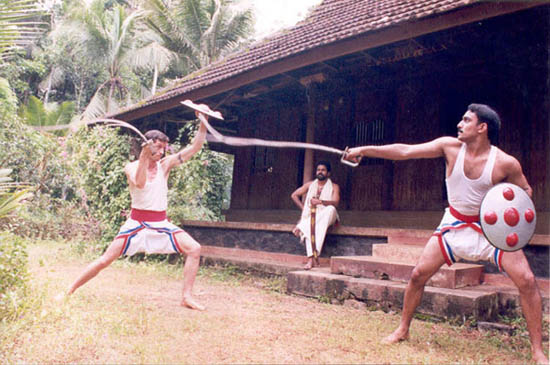
Some examples of Kalaripayatt being practiced:
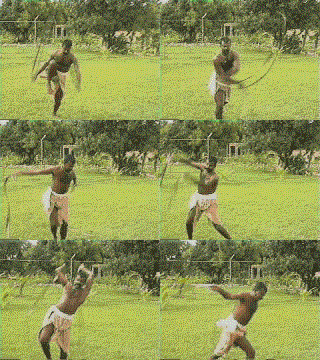
And with a version of the Urumi:
TheSkyTraveller said:
I don't know if this weapon was very practical, though. It's probably a more exotic sort of thing.
Oh, it was used (was the favourite weapon in Kerala), but not widely, mostly due to the extreme danger as I said previously and to the tremendous level of skill needed (generally takes 15 years to master). It's used along with a shield for self-protection because if the wielder fails to keep the correct speed, wrist-work and pose, the Urumi will coil around him and most probably decapitate him. That's why it's somewhat of an exclusive weapon.
Since it's very difficult to control and require utmost concentration, it was only taught to the rarest and most expert students, as agility and mental sharpness count more than raw power when using it. Twirling and controlling the Urumi is said to be an art by itself (looking like a dance). It can be used in a lot of ways besides what we see in the Guts/Silat duel, you can make dust clouds or use light reflection to blind the opponent, and in the darkness (ambush) it's easy to make him feel like there are several enemies. Of course when used against multiple opponents the Urumi can inflict heavy injuries to the aggressors. You also can hang it from trees, so the enemy would run into it unaware and get cut badly, or set one between two poles so it'd slash some guy or horse's legs. Lastly, you can put oil on the tip on the blades, and light them on fire (crazy -__-;; ).
As for some history, it's recorded as the most popular weapon out of those described in the Ballads of North Malabar, and Unniarcha, one of the heroines of these ballads, was said to be an expert in its use (I've also read that she was the first to ever use it). There's also Kudiveeran, a hero god, that performed an especially acrobatic and martial thottam. After singing the thottam myth, he danced with a Urumi. See this:
Now, my super exclusivity: a
Urumi dancing demonstration! (7MB and poor quality, but that's all I've got)
TheSkyTraveller said:
(info thanks to my husband who saw one while at a museum in Jaipur, India)
I bet he didn't take a picture... I know you read this man, you suck! ;D
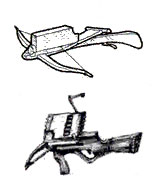
While we're talking about historical inspiration for unusual weapons in Berserk (e.g. the ones Mozgus' disciples use also come from real pieces), here are the probable inspirations for the repeating crossbow Guts uses: 2 Chinese crossbows, the "Cho-ko-nu" (a light crossbow), and another which name I don't know (lower one).
The chu-ko-nu has a magazine on top that can contain up to 10 bolts. The cocking and reloading action is worked by a single lever, pushed forward and then pulled back. This allows a faster rate of fire than its western counterpart (but it's heavier and has a poorer range). Up to two bolts can be reloaded in the magazine, and it was common for competitions to be held on the quickness of reloading.
The second model was used by the Chinese since at least 210 B.C.. The repeating design uses a gravity-fed box magazine, that was situated above the bolt track. When the lever at the rear of the crossbow was first raised and then lowered, the box moved forward, caught the string in a wooden recess and drew it to full cock, dropped a bolt into the track and released the string. These crossbows were neither powerful nor accurate, but they could launch a bolt almost every second or so until the magazine emptied. Poison was usually smeared on the points to increase their lethality.
Miura's not joking about historical references. ;)